BLACK HOLES
Microquasars are compact laboratories for relativistic jets
BY ViewGalaxies Research DeskARCHIVE RECORD1 min read
A stellar-mass black hole in a binary system can launch jets and accretion outbursts that let astronomers study extreme physics much closer to home than a distant quasar.
What the evidence actually shows
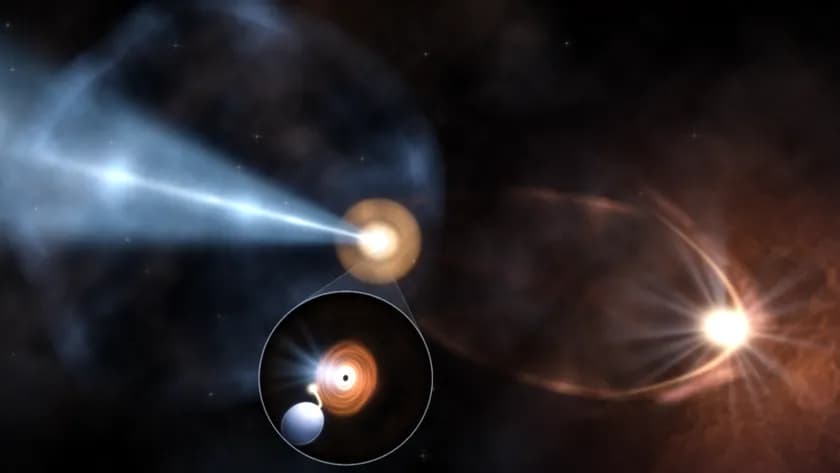
In a binary system, gas pulled from a companion star forms an accretion disk. Magnetic fields and rotation can channel some material into narrow jets moving at relativistic speeds.
Why this matters
Microquasars let scientists compare the same accretion physics across scales: stellar systems in the Milky Way and supermassive engines in distant galaxies.
“Scale changes the size of a black hole, not the need for evidence.”
Observable signatures
- ▸X-ray variability.
- ▸Radio jets.
- ▸Orbital motion of the companion.
- ▸Spectral changes during outbursts.
Source and method notes▼
//Primary source: NASA.
//ViewGalaxies separates reported measurements from editorial interpretation.
//No claim in this record should be read as evidence of life unless the cited source explicitly says so.
Sources
- NASA— NASA black-hole explainer and stellar-mass black-hole context.
Article by
ViewGalaxies Research Desk
Secure Channel
Establish Telemetry Link
Receive raw telemetry, mission updates, and deep sky discoveries delivered directly to your terminal.