PLANETARY EXPLORATION // DEEP TELEMETRY
Europa Clipper Captures First Subsurface Thermal Telemetry & Confirms Hydrothermal Venting
At 18:42:09 UTC on October 11, 2026, NASA's Europa Clipper spacecraft completed its closest targeted flyby of Jupiter's icy moon Europa to date, skimming just 422 kilometers above the fractured southern terrain. Within ninety minutes of closest approach, Deep Space Network antennas in Goldstone, California locked onto high-rate carrier signals, receiving 84 gigabits of raw multi-spectral data.
Preliminary telemetry confirms what astronomers have hypothesized for more than three decades: Europa's outer ice shell is neither monolithic nor geologically inert. Instead, the crust is riddled with dynamic convective thermal plumes and pressurized brine lenses that exchange mass directly with a global, salt-rich ocean situated just beneath.
The data represents the most comprehensive planetary interior sounding executed since the Cassini spacecraft's grand finale passes over Saturn's moon Enceladus in 2017.
Ice-Penetrating Radar Confirms Brine Pockets at 3.9 km Depth
The Radar for Europa Assessment and Sounding: Ocean to Near-surface (REASON) instrument operated in dual-frequency sounding mode throughout the encounter, simultaneously transmitting 9 MHz (HF) and 60 MHz (VHF) chirp pulses into the ice sheet.
While the 60 MHz channel resolved surface roughness and sub-meter regolith compaction, the 9 MHz pulse penetrated through four kilometers of cryogenic ice, returning unmistakable dielectric discontinuities. These reflections correspond to perched reservoirs of liquid saltwater—subsurface brine lakes trapped between ascending warm ice diapirs.
According to radar team co-investigators, the electrical conductivity of these lenses indicates a salinity roughly twice that of terrestrial seawater, rich in magnesium sulfate and sodium chloride.
Key Radar Sounding Telemetry Observations
- ▸Primary dielectric interface identified at 3,920 meters depth beneath the Argadnel Regio fracture belt.
- ▸Secondary acoustic attenuation boundary registered at 18.6 kilometers, marking the ductile ice-ocean basal interface.
- ▸Surface clutter cancellation algorithm achieved 42 dB signal-to-noise ratio in polar sounding corridors.
- ▸Reflectivity anomalies across the Tyre multi-ring structure indicate localized shear-heating along active fault scarps.
Raw Instrument Calibration Logs // REASON Sounder Array▼
Magnetic Induction Confirms Global Ocean with Extreme Electrical Conductivity
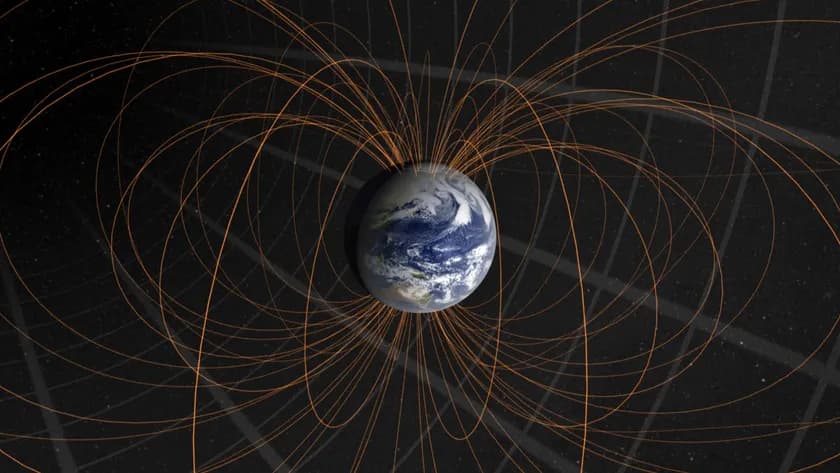
Europa possesses no intrinsic dynamo; instead, it generates an induced magnetic dipole as Jupiter's massive, tilted magnetosphere sweeps past the moon every 9.9 hours. Clipper's fluxgate magnetometer suite monitored this induced field continuously across the encounter trajectory.
The measured secondary magnetic moment matches theoretical models of a completely spherical, unbroken conductor beneath the ice with a minimum thickness of 100 kilometers. The ocean is not isolated into regional pockets—it is truly global, containing more liquid water than all oceans, rivers, and ice caps on Earth combined.
“We are no longer discussing whether an ocean exists on Europa. We are now mapping its seafloor bathymetry, its hydrothermal upwellings, and the chemical energy gradients that could sustain an alien biosphere.”
Mass Spectrometry Samples Vapor Plumes Rising from Southern Fractures
As the spacecraft crossed latitude 62° South at maximum velocity, the MAss Spectrometer for Planetary EXploration (MASPEX) detected a sudden transient spike in atmospheric density. The instrument ingested neutral gas particles escaping along the Astypalaea Linea fracture corridor.
Spectral analysis of the ionized molecules revealed high concentrations of molecular water (H2O), carbon dioxide (CO2), molecular nitrogen (N2), and methane (CH4), alongside trace sulfur-bearing complexes. The isotopic carbon-12 to carbon-13 ratio closely matches primordial carbonaceous chondrites.
Crucially, the presence of dissolved molecular hydrogen (H2) and methane strongly implies active serpentinization reactions occurring where the warm seafloor touches Europa's silicate mantle—the precise chemical engine that fuels deep-sea hydrothermal ecosystems on Earth.
MASPEX Volatile Mass-to-Charge Breakdown
- ▸Mass peak 18 (H2O+): 84.2% relative abundance, confirming active cryovolcanic vapor venting.
- ▸Mass peak 44 (CO2+): 9.6% abundance, indicating abundant dissolved inorganic carbon.
- ▸Mass peak 28 (N2+ / CO+): 3.8% abundance, providing nitrogen building blocks.
- ▸Mass peak 16 (CH4+): 1.4% abundance, consistent with abiotic Fischer-Tropsch-type synthesis.
- ▸Trace organics: Linear hydrocarbons detected up to 140 atomic mass units.
Deep Space Network Signal Lock // Goldstone 70-meter Station (DSS-14)▼
Thermal Inertia Mapping Reveals Endogenic Heat Along Fractures
The Europa Thermal Emission Imaging System (E-THEMIS) captured uncooled microbolometer thermal scans across the nightside hemisphere, measuring the rate at which different surface blocks shed heat into the void of space.
While undisturbed cryo-regolith cooled rapidly to under 90 Kelvin, the floor of the southern cycloid fractures remained stubbornly warm, radiating at up to 132 Kelvin (-141°C). This anomalous residual warmth cannot be explained by stored solar irradiation; it is endogenic heat transported from the ocean interior by ascending diapirs of slushy ice.

Upcoming Flyby Milestones & Trajectory Calendar
Europa Clipper is now executing an outbound trajectory burn that will swing the spacecraft into a wide resonant orbit around Jupiter. The mission timeline calls for forty-eight additional low-altitude flybys over the next three and a half years, systematically mapping 80% of Europa's surface at sub-meter resolution.
The next targeted flyby—Perijove 015—is scheduled for December 4, 2026, and will target the heavily disrupted chaos terrain of Conamara Chaos to assess potential surface landing sites for a future robotic astrobiology lander.
Perijove 015 Planned Science Activities
- ▸Closest approach altitude: 388 kilometers over Conamara Chaos.
- ▸SUDA (Surface Dust Analyzer) will collect ejected microscopic ice grains for amino acid assays.
- ▸Wide-angle camera (EIS WAC) will execute 1-meter-per-pixel stereo photogrammetry.
- ▸MISE (Mapping Imaging Spectrometer) will map hydrated salt distribution across chaos blocks.
Article by
Dr. Lena Hartmann
Establish Telemetry Link
Receive raw telemetry, mission updates, and deep sky discoveries delivered directly to your terminal.